CEPC Releases Reference Detector Technical Design Report, Marking International Leading Level in Collider R&D (2025-10-17)
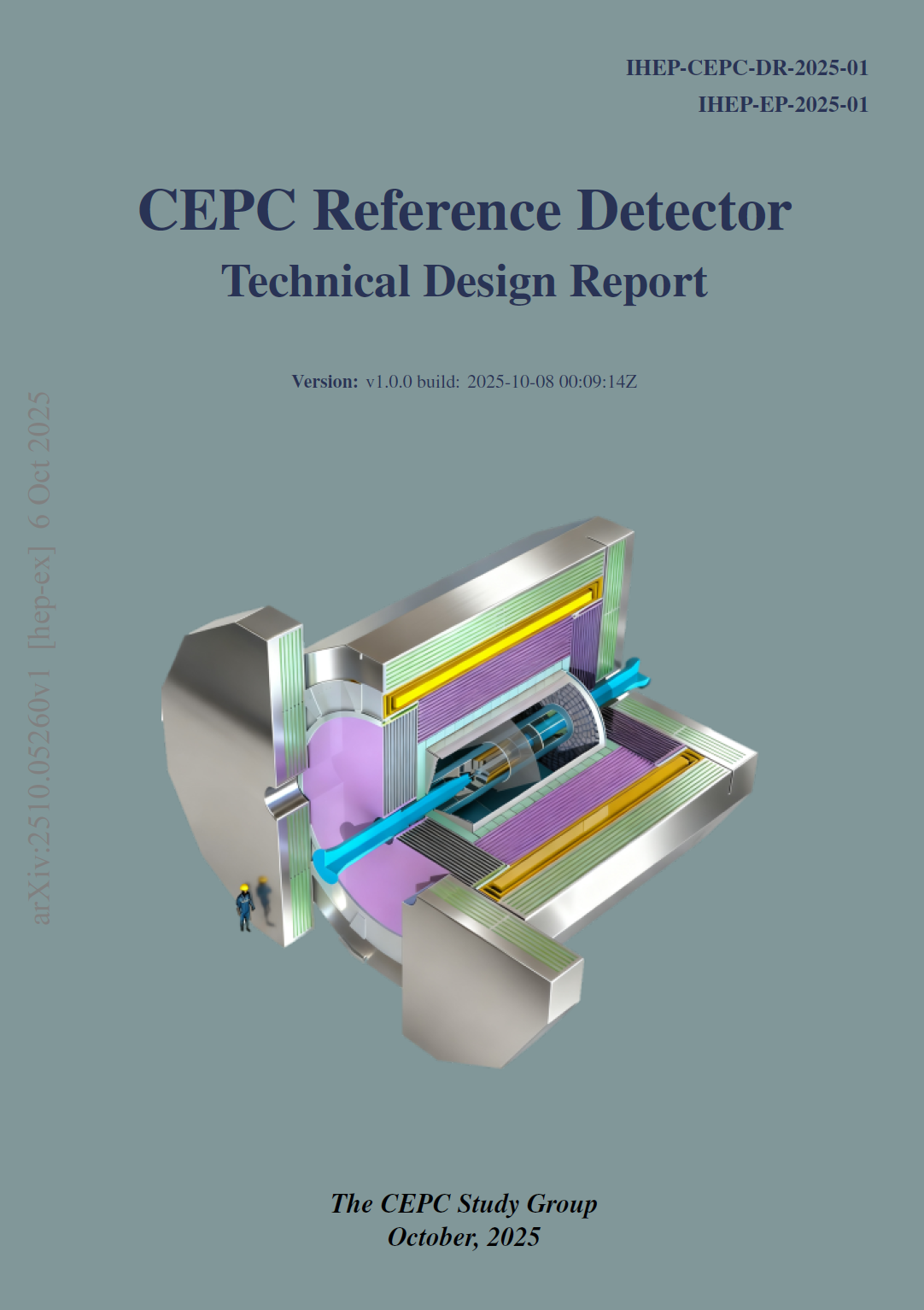
Recently, the Circular Electron Positron Collider (CEPC) research team released the CEPC "Reference Detector Technical Design Report (RefTDR)" (arXiv:2510.05260). Following the release of the "Accelerator Technical Design Report" at the end of 2023, the publication of this detector report marks the successful completion of technical designs for the two core components of the CEPC project, namely the accelerator and the detector. This lays a decisive foundation for this China-led "Higgs factory" to move from blueprint to reality.
This released detector design report is also the world's first detector technical design report specifically for a circular electron-positron collider Higgs factory, demonstrating the leading R&D capabilities of Chinese scientists in this field.
The CEPC project originated from the discovery of the Higgs boson in 2012. This particle, known as the "God particle" due to its central role in explaining fundamental physical issues such as the origin of mass, prompted Chinese high-energy physicists to formally propose the idea of building CEPC in September of the same year. CEPC is designed as a multifunctional "particle factory" that can not only serve as an efficient "Higgs factory" but also precisely explore other key particles. Its tunnel also reserves upgrade space for future transformation into a more powerful super proton-proton collider.
The advancement of large-scale scientific projects typically goes through three stages: conceptual design, technical design, and engineering design. The CEPC team completed the "Conceptual Design Report" in 2018, clarifying the scientific goals and the basic framework of the facility. Subsequently, the project entered a more in-depth and specific technical design phase, aimed at verifying the feasibility of various key technologies and completing detailed designs of core components. The "Accelerator Technical Design Report" released in 2023 and this "Reference Detector Technical Design Report" are milestone achievements of this phase.
Compared with the 2018 conceptual design, the release of the technical design report indicates that Chinese scientists have completed the verification of core components and various key technologies. The report proposes multiple innovative detector solutions. The main highlights in the report include:
- The calorimeter design introduces an electromagnetic calorimeter based on orthogonal crystal bars and a hadronic calorimeter based on high-granularity scintillating glass, both suitable for advanced particle flow algorithms, significantly improving energy measurement accuracy.
- The tracking detector employs a cutting-edge technology called AC-LGAD, capable of simultaneously performing ultra-high precision position and time measurements.
- The team successfully independently developed 55-nanometer readout chips, greatly improving performance and reducing power consumption, reaching the highest level in the current high-energy physics field.
- The first-time international development of scintillating glass that combines both high density and high light yield.
To ensure the scientific feasibility of the design, the CEPC project team established a Detector International Review Committee in 2024, chaired by Professor Daniela Bortoletto from the University of Oxford. After three rounds of in-depth discussions, the review committee concluded in September 2025 that the CEPC Reference Detector design is advanced, innovative, and superior in performance, and can proceed to the overall integration and system verification stage. At the same time, the International Review Committee provided valuable suggestions for the next steps.
The rapid advancement of CEPP has been achieved against a backdrop of intense global competition. Currently, China, Europe, and Japan have proposed four main Higgs factory schemes. Both Europe and the United States have listed participation in or construction of a Higgs factory as their highest priority physics goal. In this international race concerning the future of fundamental science, the CEPC team, with the collaborative efforts of over a thousand domestic and international scientists over seven years, has successively delivered the first complete "technical answers" in the two core areas of accelerator and detector, demonstrating China's strong capabilities and leading position in the next-generation high-energy collider competition.
With the completion of core technical designs, the CEPC project will next focus on engineering design, sprinting toward the final construction phase.
Schematic Diagram of Reference Detector Technical Design Report
|