CEPC Team Scientists Participate in European Strategy for Particle Physics Special Session (2025-07-07)
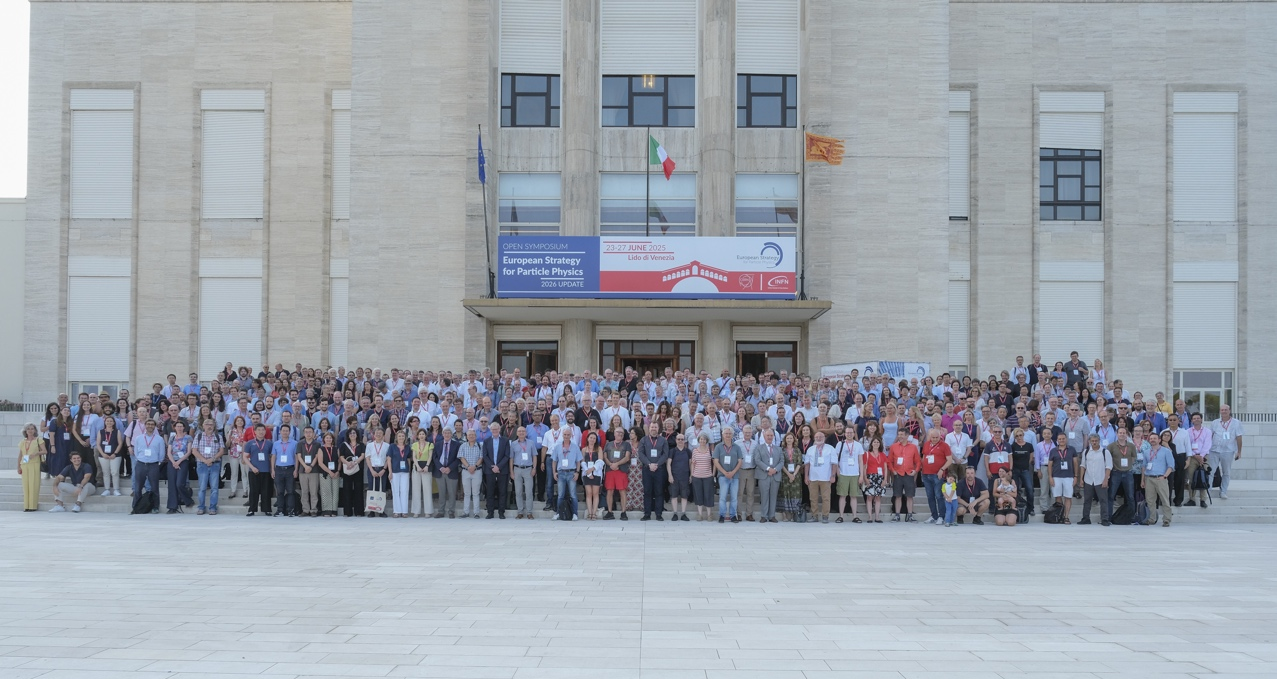
From June 23rd to 27th, the European Strategy for Particle Physics (ESPP) symposium was held at the Palazzo del Cinema on Lido Island in Venice, Italy. The core topic of this meeting was to discuss the flagship accelerator project for CERN (Conseil Européen pour la Recherche Nucléaire) following the currently operating Large Hadron Collider (LHC) project. The conference brought together theoretical physicists, experimental physicists, and engineering technology experts from the industry to deeply participate in discussions about the advantages and disadvantages of various projects, providing advice and decision-making basis for CERN's layout of the next international large-scale scientific facility. The meeting focused on discussing the Future Circular Collider (FCC) project and also explored the possibilities of linear lepton colliders, electron-proton colliders, muon colliders, and other projects. As CERN is a global large-scale scientific cooperation organization, this meeting not only invited researchers from Europe but also experts from China, the United States, Japan, and other related fields to participate in discussions and introduce their respective countries' medium to long-term development visions for particle physics. Experts from various countries engaged in enthusiastic discussions and debates on the next development direction of particle physics. The meeting was conducted in a professional atmosphere of mutual respect, seeking truth, and being pragmatic.
Chinese particle physics workers actively participated in discussions on the formulation of the European particle physics strategy. The next-generation Circular Electron Positron Collider (CEPC) project team submitted the overall introduction of CEPC and the superconducting magnet research white paper to the European strategic planning organizers. Researcher Lou Xinchou served as a member of the European Strategy Physics Preparatory Group, participating in analyzing the scientific value and significance of various projects; Researcher Yu Chenghui served as a member of the accelerator working group, providing professional opinions on accelerator physics and design; Academician Wang Yifang from the Institute of High Energy Physics, Chinese Academy of Sciences, was invited by the conference to introduce the progress and achievements made by the Chinese particle physics community in the layout of the CEPC project at the special session on the third day. Compared with other projects, the maturity of CEPC project preparation and the technological breakthroughs and progress achieved in engineering technology left a deep impression on the attending experts and received strong responses. More than ten CEPC scientists from the Institute of High Energy Physics, Shanghai Jiao Tong University, and other domestic institutions participated in this strategic symposium, introducing Chinese particle physics research to colleagues from Europe, Japan, and the Americas, and discussing future cooperation plans. Young scientists from our institute took this opportunity to meet more important international peers, establish direct contacts, and lay the foundation for future international cooperation.
European Strategy for Particle Physics Symposium
|